
What is Frontline Foam?
Frontline Foam is offering the leading herbicide-free solution for controlling unwanted vegetation, including weeds, moss and algae. Its patented low-pressure process combines hot water and our biodegradable foam. The foam is made from natural plant oils and sugars making it safe for use around people, animals and delicate environments.
Services We Offer
Premium, herbicide-free surface treatment solution, providing effective control without the use of chemical herbicides. It is environmentally responsible, safe for public spaces, and suitable for use around children, pets, and sensitive landscaped areas.
Treat all existing weeds across the site
Apply treatment to prevent the germination of dormant weed seeds
Treat all areas affected by moss growth
Treat and remove algae from play surfaces (soft-pore surfaces)
Clean and disinfect all bins, including dog waste bins
Clean and disinfect all handrails
Thoroughly clean all play surface areas
Why Choose Frontline Foam?
Cleared for use as organic, non-toxic, and safe by multiple regulatory bodies worldwide
Approved for unrestricted use across all territories in which we operate
No need to cordon off areas before, during, or after treatment, minimising disruption and downtime
Suitable for treating a wide variety of surfaces, while also cleaning and sanitising
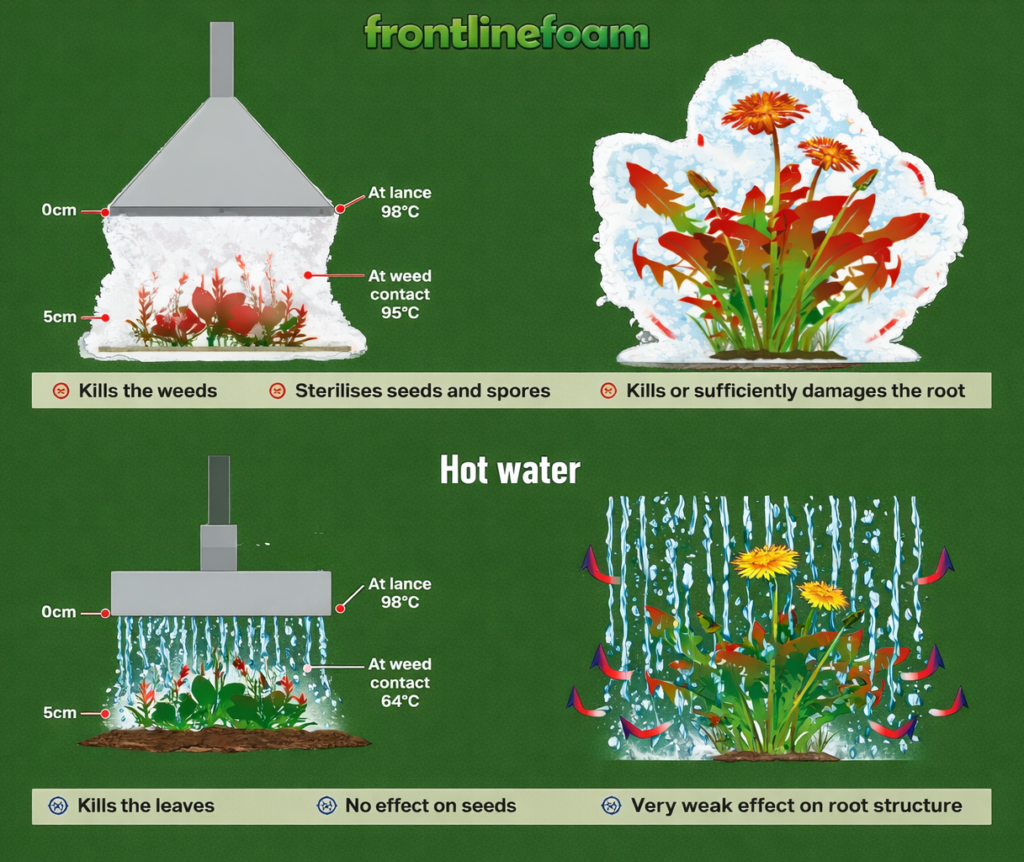
More effective than hot water treatments, operating at a higher contact temperature
Kills weeds completely by treating both visible growth and dormant seeds, rather than just scorching the leaves
About the Technology
We have already successfully delivered a range of works across the borough for local businesses, private individuals, and several departments within our local authority. This technology was adopted to significantly reduce our reliance on herbicides in public spaces, while also enabling us to treat weeds and moss-affected surfaces in adverse weather conditions—situations where traditional chemical treatments are often ineffective or unsuitable.
The principle behind the system is the application of hot water, which destroys plant cells on contact and sterilises weed seeds within the ground. This results in a net reduction of future weed growth, delivering longer-lasting results and reducing the need for repeat treatments, therefore reducing the long term cost.
Weed Coverage
This technology is effective against all types of weeds, including perennial, annual, and invasive species. Examples include:
Perennial Weeds – White Clover, Daisy, Dandelion, Creeping Buttercup, Crane’s Bill, Ribwort, Greater Plantain, Ragwort, Couch Grass, Bindweed, Ground Elder, Cleavers, Nettles, Docks, Mare’s Tail.
Annual Weeds – Meadow Grass, Chickweed, Fat Hen, Charlock, Groundsel, Hairy Bittercress, Prickly Milk/Sow Thistle, Oxalis, Speedwell.
Invasive Species – Giant Hogweed, Japanese Knotweed, Pennywort, New Zealand Pygmy Weed.
The principle behind the system is the application of hot water, which destroys plant cells on contact and sterilises weed seeds within the ground. This results in a net reduction of future weed growth, delivering longer-lasting results and reducing the need for repeat treatments, therefore reducing the long term cost.
Algae & Moss Treatment
Moss and algae present an ongoing challenge for local authorities, utility companies and contractors to control. It can be costly to deal with and treatment can be fraught with environmental and safety concerns. We provide an award-winning solution. Our service removes moss and algae quickly, effectively and safely helping to reduce costs and avoid health and safety risks.
Instant Kill – Long Lasting Results
Unlike most weeds, moss roots sit on the surface of the plant. This means that when Our service is added directly to the plant, its combination of hot water and our specially formulated biodegradable foam, Our service, instantly coats and attacks the roots, killing the moss and stopping it from returning for at least 12 months.
When it comes to tackling moss and algae, the process applied using our delivery system is the most effective solution on the market, even when compared to herbicide alternatives. Our service can be used on moss and algae in any season and in any weather. It completely eradicates the plant with just one treatment per year.
Further Uses
Health & Safety Benefits (EPA Approved)
The use of our service to treat moss and algae in public spaces delivers clear health and safety benefits, achieved in two key ways:
1. Herbicide-Free Solution – Our service is 100% herbicide-free, eliminating concerns associated with the use of increasingly controversial chemical herbicides such as glyphosate. This makes it particularly suitable for use in sensitive public areas and high-footfall environments.
2. Slip and Trip Risk Reduction – Our service can be safely applied across both hard and soft surfaces, including playgrounds, sports facilities, and large industrial areas. Following just a single treatment, moss and algae are effectively eradicated, significantly reducing slip and trip hazards for both the public and employees.
As an EPA-approved organic biocide, our service provides a disruptive and innovative solution for not only weed treatment but also a wide range of municipal cleaning and sanitisation tasks, including but not limited to general street cleansing, chewing gum removal, and power washing applications.
How/ Why Is It Effective
The active ingredient is the heat from in the hot water.
Just like the roof on your house, the foam stops the heat from the hot water escaping to the atmosphere, trapping and holding it directly on the plant/ surface for an extended period of time. This allows it to work in the most effective way possible.
The heat penetrates the leaf’s waxy outer layer, travels down the stem, and in to the roots – killing or severely damaging the plant, causing it to die.
The longer a plant is kept in the kill zone (temperatures above 57 ˚C) the more effective the heat will be at killing the plant. And so by providing a layer of insulation on top of the water the foam allows the heat in the hot water to be held within the kill zone for longer.
Changing Legislation and Public Expectations
Herbicide legislation, alongside public opinion, is changing rapidly. More than ever, there is a growing expectation to reduce or eliminate herbicide use wherever possible, particularly in public spaces. We believe that herbicides are likely to be restricted or banned in many—if not all—public environments in the near future, requiring organisations to adapt their approaches.
The use of glyphosate in public spaces has been the subject of long-standing debate. Questions remain around its general safety in both public realm applications and agricultural use, and this ongoing uncertainty continues to drive public concern.
As a result, legislation and policy are evolving worldwide as scrutiny around pesticide use increases.
In the UK, this shift is reflected in the National Action Plan (NAP) 2025–2030, which aims to reduce potential environmental harm from pesticides by 10%. The plan encourages the adoption of non-chemical, nature-friendly approaches and Integrated Pest Management (IPM) strategies.
In response, many UK local authorities are already actively moving away from glyphosate use within public amenity spaces and are trialling alternative weed-control solutions that align with both legislative direction and public expectation.